Loire Valley Wines - Crémant de Loire, Vouvray, Rosé D’anjou for the Summer
The #Winophiles bloggers are
invited by Jill Barth from L'Occasionto explore wines from the Loire Valley of France this summer. I had the opportunity
to sip a few beautiful Loire Valley wines last winter in a wine tasting event in New York.
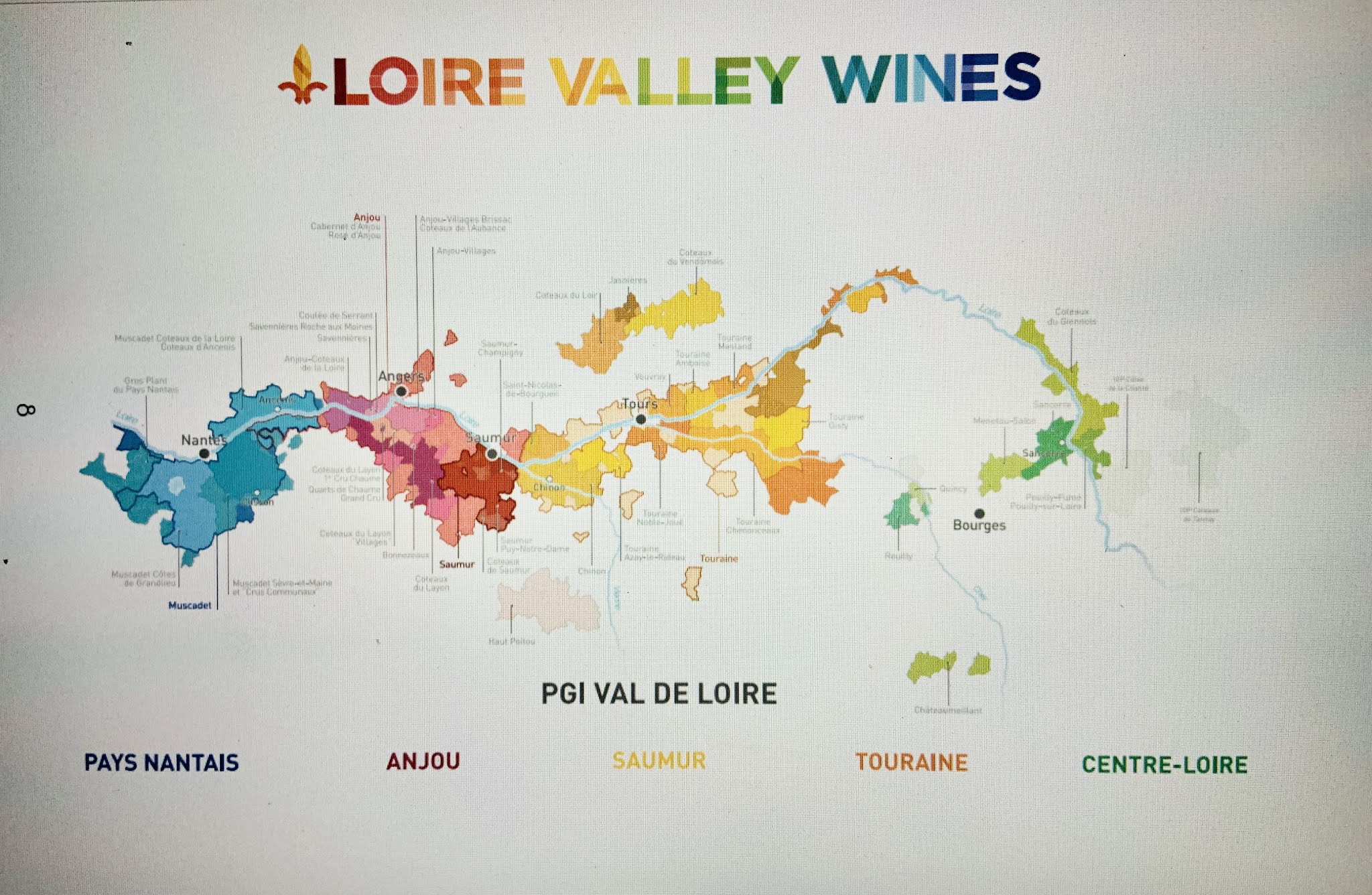
What resonates with me the most from the tasting is the diversity of wines that come from this wine region, the largest in France. You could effortlessly find wines from Loire Valley that will suit for each season of the year, every occasion and budget. Let’s “travel” to this wine region...through the lenses of the Langlois-Chateau Crémant de
Loire Blanc Brut, Vigneau-Chevreau Vouvray Cuvee Silex Sec, and Chateauvieux Rosé D’Anjou.
Loire Valley is home of 51 AOP regions and 4 PGI Regions (Credit: www.loirevalleywines.com)
For
geo, terroir and wine geek details of Loire Valley, you could check out my
previous Bourgueil (a Loire Valley AOP) blog posted in January this year. I’m zeroing right into
the wines and see how each of these wines helps you “taste” Loire Valley.
A Crémant that has bready and dried lemon rind notes. Taste almost like a Champagne, without the hefty price tag!
Langlois-Chateauconsists of 95
hectares of vines in multiple Loire Valley AOPs, including 51 hectares in
Saumur, 11 Ha in Saumur Champigny and 33 Ha in Sancerre. Langlois-Chateau has
been making sparkling wines since 1855. The French sparkling wines made outside
the Champagne wine regions are called Crémants. Check out a recent post which I
explored Crémants for more information. Particularly amazing about this Crémant de Loire is its
freshness, complexity and balance. This Crémant is a blend of 40% Chenin Blanc,
10% reserve wines, and Chardonnay and Cabernet Franc making up the rest. At the initial
sips, the vibrant green apple freshness and fine bubbles came to the forefront.
Following with a few more sips, the yeasty and a tad dried lemon rind leveled
up. The finish was long with a bit honeyed richness. This Crémant has that kind
of “Old World” mouthfeel which savvy sparkling wine drinkers are looking for.
Lemony acidity, nuanced with notes of a tad honey, apricot and baking spice, a long finish with minerality
Vigneau-Chevreauhas been a family run business since 1875. Currently, under the management of brothers Stephane and Christophe
Vigneau, the Chateau, which is located in the Saumur AOP of Loire Valley, consists
of 28 hectares of soils that are primarily of limestone, clay and silex. These
soils are most favorable to the cultivation of Chenin Blanc. Vouvray is only made of 100% Chenin Blanc. While the lemony acidity was not surprising from this
grape, this Vouvray was nuanced with notes of a tad honey, apricot and baking spice.
I was very intrigued by the long finish which the minerality surfaced. I had to
admit that this wine was the reason why I ate so much cheese at the tasting
event as it just interacted so well with the nuttiness and the brininess of the
cheese. Of course, gluttony is my main sin.
Photo Credit: Cellar Tracker
Chateauvieux
Rosé D’Anjou (SRP$10.99)
Chateauvieux
locates in the Anjou and Saumur AOPs of Loire Valley. The Rosé D’Anjou is a poster
child of the region as the large economy of scale allows producers to use machines
and automations in the process, driving the cost of the wines down while
maintaining high quality of the wines. With strawberry on the nose and lively
acidity, the Rosé D’Anjou was a screaming for summer in a glass.
Chinese
Foods to Pair with the Wine
While
cheese is a great pairing option for these three wines. I would also recommend
some Chinese foods that I think will kick up a notch of the tasting experience. Fried
spring rolls and fried shrimp toastare
the perfect accompaniments to the Crémant de Loire. With the Vouvray, I would have
a Dim Sum feast with it as its minerality and warm spice notes gives this wine
an edge to deal with the seasoned meaty Dim Sum dishes such as steamed beef
balls with cilantro, steamed pork riblets in black bean sauce and braised chicken feet in oyster sauce. To
pair with the Rosé D’Anjou, I would do a platter of Chinese desserts such as
red bean bunsand fried sesame balls.
See
what other amazing Loire Valley wines other #Winophiles bloggers are sipping:
Double down on a hard-to-find Red Vinho Verde at the Vinho Verde Experience Event
Vinho Verde is the biggest wine region (DOC) of Portugal, up
in the cool, rainy, lushly green north west. A Vinho Verde also literally translates
as “green wine” or “young wine”, indicatively referring to the white grape varieties,
which account for 85% of the wine production in the Vinho Verde region. Cindy Rynning
from Grape Experiences and Liz Barrett from What’s in that Bottleinvited
the #WinePW to discover Vinho Verde. I honestly didn’t have a Vinho Verde wine
to taste right in front of me. I did have the fond memory of a Red Vinho Verde
- Quinta das arcas Vinhão Escolha, taking three years to hunt down one...
5 Fun Facts of Vinho Verde:
You can’t beat the price. Vinho Verde's SRP starts at $5.
Reds (e.g., Espadeiro, Padeiro and Vinhão) and Rosés account
for 14% of the total wine production in Vinho Verde DOC.
Sparkling wines were permitted to be made in the DOC since
1999.
Single-variety Vinho Verde wines, mostly made from Alvarinho or Loureiro, are age-worthy.
The blend of white grapes (e.g., the previous two grapes, Arinto, Avesso, Azal and
Trajudura), which are found in most Vinho Verdes, have lesser potential for
cellaring.
Red Vinho Verde is dark,
high in acidity, low in alcohol, made primarily from the late-ripening,
red-fleshed Vinhão
grape.
Photo Credit: Wines of Portugal
The Hunt Down of a Red Vinho
Verde
My experience with Vinho Verde started with the New York City Vinho Verde Experience Tasting Event back in 2017. Back then, I was hired as a pourer in the event, learned all about Vinho Verde myself, and talked about the wines I poured. However, even I learned about the Reds from the brochure, there were hardly any red Vinho Verde, not on my tables or others.
Pouring at the Vinho Verde Experience Event
In 2018, I went with a group of friends to the same event hosted atop a beautiful rooftop of a converted warehouse building. We tasted a lot of Vinho Verde cocktails as well as a lot of white Vinho Verde and some Rosés. But again, there were no sight of Reds.
Last year, I went back to the event that was held at night in a mid-town Manhattan hotel for a very rush tasting, in and out within half an hour, as I had my teenage daughter waiting for me in the hotel lobby (don’t be an irresponsible mom like me!). I eventually found and tasted a red Vinho Verde - Quinta das arcas Vinhão Escolha 2014. What a big contrast with the thirty Vinho Verde I tasted there…Vinhão Escolha is violet but transparent in color. It’s dry, medium-bodied and tannic, and has high acidity, pronounced raspberries with a touch of grass, chocolate and oak. Unfortunately, this wine is still not available online or via retail in the US. The representative of Quinta das arcas told me that they were looking for a distributor.
.
SRP 16.80€ per the Winery's website; Vinhão 100%, ABV 12%
Pairing Ideas with Vinhão Escolha
I think the sky is the limit in terms of food pairing options with this Vinhão Escolha. It could be heartier finger foods such as stuffed mushrooms, mini meatballs, fried calamari, or entrée such as roasted chicken or duck, a lean cut of steak, or a burger. In the context of Chinese food pairings, I would strongly recommend Char Siu (roasted BBQ pork). For me, if I could get hold of this bottle again, I would cut out the cooking and just order from my favorite Chinese take-out place…anything with a bit sauce from the menu will go.
Take a look at which Vinho Verde the other #WinePW bloggers is drinking:
Pairing Bibi Graetz Casamatta Toscana Rosato with Drunken Cold Chicken Wing and Pork Knuckle, and Sautéed Julienne Leek
Having
a stronger preference over red wines and typically shying away from the sun, sitting
at the patio and enjoying chilled wines is not my usual summer pastime. However, the summer of 2020, in so many ways,
is very different from the past…staying in the house, no family travel plans,
no summer street fairs, no wine tasting events. To extend my living space to outdoor,
we have upgraded our patio with elevated garden boxes for some annuals and new
patio furniture. All out of a sudden, checking out how my flowers are doing becomes
a daily ritual and, slowly but surely, having our wines and meals outdoor is
what I look forward to every evening. Lauren
from The Swirling Dervish invited the #ItalianFWT bloggers to discover the pink wines from Italy’s indigenous
grapes. That helps me expand my summer patio wine list. Let’s sip some Bibi Graetz
Casamatta Toscana Rosato and devour the chilled drunken chicken wings and pork knuckle
plus some sautéed julienned leek.
Bibi Graetz Casamatta Toscana Rosato 2018 SRP$12.99: cherry plum (GMO for sure), fuller-bodied, a good balance of acidity at the end; Dry Port?
What
is Rosato?
Rosatos
are pink wines coming from all over Italy. They are made with a wide variety of
Italian indigenous grapes. The choice of grapes and winemaking methods, either direct
pressing of red grapes or “saignée method” (bleeding off must from tanks to
avoid too dark of the color from skin contact) presents a diverse and fun world of Rosato – different regions, shades of pink or light red, weight or body, aromas, tastes
and price ranges.
Soft citrusy finish that kind of zips all the fruitiness of this wine and leaves you with a refreshing and clean mouthfeel at the very end!
This Rosato
doesn’t taste like Rose!
BibiGraetz Winery was found in 2000 when Bibi Graetz turns his passion of wines from drinking it
to making it. Growing up in a family of artists, it’s not hard to find the
artistic strokes on the wine labels. Not only I like the label of this Bibi Graetz
Casamatta Toscana Rosato 2018, I’m also so excited to taste my very first
Rosato which happens to be awarded a 91 rating from James Suckling.
This Sangiovese-based Rosato is strawberry and cherry on the nose. My first sip of it really sent some shockwaves…what
is this? A dry Port? I immediately asked my husband, who is a Port lover, to “verify”
the taste. It also tastes like a lighter Port to him too. But what makes this
Rosato so interesting is the soft citrusy finish that kind of zips all the fruitiness
of this wine and leaves you with a refreshing and clean mouthfeel at the very
end!
Making drunken chicken wings and pork knuckles takes some time but it is so worth it!
Drunken Chicken Wing and Pork Knuckle
with Sautéed Julienned Leek
With this fuller-bodied and solid Sangiovese-based
pink wine, I decided to make some drunken chicken wings and pork knuckles that are
served cold. I boiled the wings and knuckles for about ten minutes and washed off
the fatty floatie stuff from the meat under the running water. I then fully cooked
the wings and knuckles an Instant Pot (stovetop is perfectly fine too). One thing
to keep in mind is not to stew the meat so it becomes too mushy and the skins
of the wings and knuckles need to be intact. In a separate pot, I was making a
brining liquid by boiling two cups chicken broth, ¼ cup rice vinegar, some Sichuan
peppercorn, anise, scallion, ginger, salt, and pepper. After the broth was
cooled off in a large bowl, I added ½ cup of clear Chinese cooking wineto the broth and submerged the wings and knuckles in the broth. Leave the meat
in the fridge for at least 4 hours.
Yes, it's a meaty pork knuckle. The pork skin is not fatty at all as the rice vinegar in the brining liquid takes care of it.
When you bite into the bouncy skin of the
wings and pork knuckles, you know that all the work is totally worth it. The
brining process turns the heavy meat into tasty cool summer eats that are substantial
but not fatty, appetizing, umami, lightly sour and gingery…overall, a good match
to the honest and impressive Bibi Graetz Casamatta Toscana Rosato.
If you don't like leek potato soup, maybe try to sautee leeks. I am quite happy with this leek dish.
With the vegetable side, I julienned a
whole leek and sautéed it with Laoganma Spicy Chili Crisp until the leek was tender and slightly under-cooked so that it still had that
crunch to it.
Julienned leek sautees very fast and can be served cold. The leeks retains the vibrant green color after its cooked too.
The Laoganma sauce is an all-purpose condiment for spicy food
lover. It is red pepper-based with oil that is infused with the spiciness. The
crunchy peanuts and tinny dry tofu cubes in the sauce also add a lot of fun to
your sautéed food too. This sautéed leek is spicy, oniony and literally healthy.
Who can imagine one can eat a whole leek and drink Rosato – yes, I can… at my new patio.
Got this leek from a nearby farmer's market. It costs me $2.5 for three whole leeks. A better alternative to onion, in my opinion.
Let's check out which Rosato our #ItalianFWT friends is drinking:
David from Cooking Chat writes about Cerasuolo d’Abruzzo: Pairings with My Favorite Italian Rosé
Pinny from Chinese Food and Wine Pairings writes about Pairing Bibi Graetz Casamatta Toscana Rosato with Drunken Cold Chicken Wings and Pork Knuckle, Sautéed Julienne Leeks #ItalianFWT
Being a history buff and journalism major, I was fascinated about the 20th
century history of Eastern Europe. When I was 19 years old, I decided to
travel with a friend to several Soviet Union ruling Eastern European
countries like Bulgaria, Hungary, Poland, Yugoslavia, Czechoslovakia for
more than two months during the freshman year summer break. Back then, as a
traveler on a shoestring budget, my focus was not on wines but rather on guarding
my backpack from theft during the occasional overnight stays (a.k.a
sleeping) in the train stations. Shortly after this eye-opening trip, I
visited Moscow, St. Petersburg and Vladivostok multiple times to see how the
communist party controlled the press! Jeff Burrows from
Food Wine Clickhas this cool connection with
VINOvationsand
Wine of Moldova
USAand arranged samples for the #WinePW bloggers. For me, tasting Moldovan
wines gives me a reason to revisit the map of the former USSR and to be
nostalgic about my exciting young adulthood.
Staying with a hosting family in Krakow, Poland
Terroir of Moldovan Wines
The Republic of Moldova is a country located in Eastern Europe, bordered by
Ukraine to the east and Romania to the west. Its geographic location
embraces a moderate continental climate with short and occasionally very
cold winters and long summers. Moldova’s landscapes vary considerably from
endless steppes of the east, to forested hillsides of the central zone, and
on to the vast Bugeac Plain in the south. The diverse landscape allows
Moldova to offer a wide portfolio of wines, ranging from cool-climate wines,
ice wines from noble rot, to wines from early ripen grapes.
Gogu Blanc de Merlot 2018/ Rosu de Purcari 2015/ 310 Altitudine Cabernat Sauvignon - Feteasca Neagra 2017
5 Wine Facts of Moldova
The Republic of Moldova has the highest density
in vineyards in the world – new vineyards are added to the Protected Geographical
Indication (PGI/Appellation) year after year.
Still and effervescent white wines (55%) dominate
the wine production in Moldova, followed by red (35%), rose (8%), and licorous
white, rose and red (2%).
Moldova cultivates Western European, Black
Sea Basin and indigenous grape varieties - 70% of which are white varieties (e.g.,
Rkatsiteli, Sauvignon Blanc, Chardonnay, Aligoté), which are located
predominantly in the Codru region, and 30% are red varieties (Cabernet
Sauvignon, Merlot, Pinot Noir, Saperavi) that are typically grown in the
southern regions.
USA is the 10th most important export
market for Moldovan wines.
Moldova is internationally famous for its
vast underground cellars at Cricova and at Mileștii Mici - the latter holds the
Guinness World Record for the largest wine collection in the world.
Moldovan Wines PGIs: Valul lui Traian (southwest), Stefan Voda (southeast), Codru (central) and Divin (distilled wines) / Photo Credit: Wine of Moldova
Protected Geographical Indications (PGI – Appellation) of Moldova
The four Protected Geographical Indications in Moldova are Valul lui Traian
(southwest), Stefan Voda (southeast), Codru (central) and Divin (which is
for spirits distilled from wine through double distillation and aged for at
least 3 years in contact with oak produced anywhere in Moldova).
Rosu de Purcari 2015: Wild Dark Berries, Complex, Ripe, Rich, and
Intense
Rosu de Purcari 2015 (SRP$39.99)
Purcari Chateau, located in Stefan Voda - near the Dniester River and Black Sea, is one of
the most celebrated wineries and well-known wine brands in Eastern Europe. Found
in 1827, its exceptional wines help Purcari win more than 200 awards at the most prestigious international
wine competitions. Also the winery’s famous underground cellars were built
in 1827, becoming the must-see for visitors visiting Stefan Voda.
Rosu de Purcari 2015: Cabernet Sauvignon 50%, Merlot 40%, Malbec 10%
Purcari Chateau's Rosu de Purcari 2015 is a blend of Cabernet Sauvignon
50%, Merlot 40%, Malbec 10%. This wine is a dream of red wine lovers. Its
complexity and deepness is over-the-top, coupling with a surprise touch of
sweetness, smoothness and a long lasting finish.
310 Altitudine Cabernat Sauvignon - Feteasca Neagra: Bright
acidity, black cherry, lightly oaked, well-structured and
medicinal
Fautor Wineryis the most awarded Moldovan winery in 2016 to 2018. Its strong suit is to
have a portfolio of rare varieties that are considered as exclusive wines
globally. Fautor Winery and its vineyards are located in the Tigheci
microzone, which is known for producing Moldova’s high-quality whites and
reds, in the Valul lui Traian region.
Gogu Blanc de Merlot: Textured, Saline, Stone-fruit,
Weighty for White, Medium-bodied
Gogu Wineary'sstory began in 2004, when the founder and winemaker of the winery, Ilie
Gogu, has decided to experiment with home winemaking after graduating from
the Technical University of Moldova as a wine technologist. Gogu Winery
locates in the Stefan Voda region, where vast majority of winemakers from
this PGI put a stronger emphasis on red grape varieties. Ilie Gogu however
has decided to emphasize white varieties when planting his vineyards and has
balanced a decent diversity of red varieties such as the Western European
Cabernet Sauvignon, Merlot and Malbec, the legendary Georgian
Saperavi, and local Feteasca Neagra.
Korean Sushi - Kimbap (roasted beef rolls, fish sausage rolls and roasted chicken rolls)
Korean Sushi – Kimbap
Korean sushi “kimbap” is very similar to Japanese sushi in terms of using
cooked seasoned sushi rice and toasted nori seaweed as the base. The major
differences are the ingredients you put inside the sushi. While the Japanese
sushi favors raw fish like salmon, tuna, yellow tail and mackerel and raw
vegetable like cucumber and avocado, Korean sushi uses cooked meats like
beef, chicken or pork bulgogi and blanched/preserved vegetable like cooked carrot, spinach and kimchi. In my opinion, the Korean sushi is more fun and
you can be creative and improvise to put in so many different types of meats and
vegetables to create your rolls. It’s less expensive to make and more
fool-proof for success as a party food as you don’t need to use raw fish.
Get sushi rice from the grocery store as long grain rice will not have the
texture that’s soft and sticky enough for making kimbap. Once the rice is
cooked and cool off, add salt and sesame oil to the rice for taste. The nori
seaweed sheet can be found in an Asian grocery store.
To pair with the Gogu Blanc de Merlot, I have made
fish sausagekimbap. The fish sausage is a must-try snack for people who even don’t like fish
as it only has a very mild fish taste to it. The texture of the
fish sausage resembles SPAM. It is a processed food but really works well
with the cucumber, egg and cooked pepper in the kimbap. This Gogu Blanc de
Merlot is one of my favorite whites I tasted so far in this summer. It’s
medium-bodied and a tad saline, paring well with the umami seaweed and the
savory fish sausage. The citrus and tropical fruity notes of the wine come
out even more when having this lighter kimbap.
Gogu Blanc de Merlot, a weighty white that is versatile and dynamic and just what one needs for summer dining
For the 310 Altitudine Cabernat Sauvignon - Feteasca Neagra 2017, I paired it with the shredded roasted chicken kimbap.
I would say any cold-cut chicken or turkey slices you have handy will also
serve the purpose. The 310 is a medium-bodied red that is complex but causal
enough to pair with lean protein. I have no doubt that I can finish the
bottle without the need of any food. But the chicken kimbap in fact is a
good match as this wholesome chicken rice bites will help you drink even
more.
310 Altitudine Cabernat Sauvignon - Feteasca Neagra: a cool label, a blend with an indigenous Moldovan grape, a dream for red wine lovers
The roasted beef kimbap is my favorite out of all three kimbaps as it’s
hearty and a meal by itself. I added some creamy horseradish sauce to the
beef as well to make it extra flavorful. The Rosu de Purcari blew my socks
off by itself with its tannic yet elegant characters but was also a no
brainer pair to the beef kimbap.
Foods and wines are the best way to learn a culture
Visiting Moldova to taste their wines is definitely on my bucket list now as
these wines are truly impressive. What’s more important to me is to reconnect
my adventurous younger self…but this time it’s through the lens of
wines.
Note: wines are samples. Opinions are my own.
Check out other #WinePW bloggers’ Moldovan wines stories:
Andrea at The Quirky Cork shares “Cooking Out with Moldovan Wine”
Liz at What’s in that Bottle shares “Moldova Mashup: Wines of Moldova & Foods of the World“
Terri at Our Good Life shares “Special Celebration and Moldova Wines”
Wines from New York Finger Lakes are no stranger to wine
lovers in the US and globally due to their world-class quality and the diverse
wine portfolio the region has to offer. While Rieslings are the Finger Lakes’ signature
variety, other varieties such as Cabernet Franc, Gewurztraminer, Chardonnay,
Pinot Noir and Lemberger have been added to the mix. Thanks to Linda Whipple from My Full Wineglass,
some #WinePW bloggers are very lucky to receive samples from the wineries in
Finger Lakes. In this super exciting wine delivery, I received Fox Run’s Silvan
off-dry Riesling and Semi-dry Riesling and Stony Lonesome’s Cab Franc Rose. The
best way to enjoy these awesome wines, in my opinion, is to pour myself a full
glass while eating some quick-prepped seafood and watching the sunset at the beach.
New York Finger Lakes Wine Region
The Finger Lakes wine region in New York is the home of 140 wineries. It is located south to Rochester and
Syracuse, encompassing over 9,000 square miles and including the 11 Finger
Lakes, part of Lake Ontario and a section of the Erie Canal.
New York Finger Lakes (Photo Credit: Finger Lakes Wines Alliance)
There are three AVAs designated in this region - Finger Lakes
AVA, Cayuga Lake AVA and Seneca Lake AVA, which were established since 1982. The four main lakes of the Finger Lakes AVA include
Canandiauga Lake, Keuka Lake, Seneca Lake and Cayuga Lake.Each lake showcases its own unique
viticulture characteristics and resulting unique flavor profiles.
Photo Credit: Finger Lakes Wine Alliance
The Finger Lakes were carved out by successive waves of
glaciers for hundreds and thousands of years. These large and deep freshwater
lakes and the soil deposits surrounding them are the Mother Nature’s gifts to
modern winemaking, forming the foundation of cool-climate wines in this region.
The soil types include grain size distribution and protolith composition, with the
presence of clay and limestone in the subsurface. Grain size and texture mainly
affect drainage, a critical parameter of vineyard performance.
The average temperature of much of central New York is too low
for wine production. Most of the vineyards in the Finger Lakes AVA are located
close to the lakes, particularly the deeper ones such as Seneca Lake, benefiting
from their moderating effect on temperature and precipitation, known informally
as the "lake effect." The effect brings warmer minimum temperatures
in the Winter and cooler maximum temperature in the Summer.
Silvan Riesling: subtle oak on nose and palate, off-dry, lime peel, wet slate, almond, yeasty and creamy Semi-dry Riesling: tropical fruit on the nose and palate, zesty, moderate-sweet
Fox Run Vineyards – Drink Wine, Be Happy
Fox Run Vineyards started its first grapes planting in 1984. Ten years
later, Scott Osborn and his first business partner, Andy Hale purchased the
winery from the Wildricks. In 2012, Scott and Ruth Osborn teamed up with Ruth’s
sister and brother-in-law (Kathleen and Albert Zafonte) to make Fox Run
Vineyards exclusively family owned. Now with 50 acres of east-facing vineyards
on glacial soils, the winery produces a remarkable range of limited-production
estate wines. As a certified lake friendly farm since 2002, the vineyard
practices have no negative impact on the water quality of Seneca Lake. They
minimize herbicide use and add nutrients back into our soils through
regenerative farming techniques.
The 2018 Silvan Riesling (SRP$25) spent time in small oak
barrels during fermentation. Malolactic fermentation was avoided and no lees stirring
was deployed, resulting in a complex aroma and creamy mouthfeel in this
Riesling.
The 2017 Semi-Dry Riesling (SRP$14) was fermented in stainless
steel tank at moderate temperatures, using three different yeast strains. The
wines were chilled just before reaching dryness to leave a small dose of sugar
for sweetness.
3 Brothers Wineries - BOLD. BRAZEN. BRILLIANT.
3 Brothers Winerieswas founded by Dave and Luanne Mansfield in 2006. Since then, the estate has
expanded business into microbrewery and café, drawing over 150,000 visitors per
year. Innovation and providing great customer experiences – “We’ve got
something for everyone” become part of 3 Brothers’ strategies. In 2019 they
have released 375 ml canned wine spritzers to tap on the trends of alcoholic
canned drinks market.
Cab Franc Rose: dry, floral on the nose and palate, honey, lime, medium-mouthfeel, long finish
The 2019 Stony Lonesome Cab Franc Rose (SRP$18) was overnight-soaked
prior to pressing, allowing for the vibrant red color to infuse from the skins
while not catching too much textural phenolics to extract and heavy tannins.
Quick-Prepped Seafood – 15 Minutes Work
Indulging in these beautiful wines at the beach, I really don’t
want to slave myself cooking-wise. A brief trip to the nearby Asian grocery
store gave me quick and fool-proof pairing ideas. The quick-prepped menu is crawfish
quick-boiled in Cajun seasoning, sautéed fresh mussel with a drizzle off-dry
Riesling, and shrimp wonton noodles.
Crawfish tastes like a lobster and looks like a miniature one
too. It’s super affordable, at the price of around $5 per pound. The prep instructions
are like boiling lobsters. When the water is boiling, add some Cajun seasoning
to it before dropping the crawfish in. Once the water is boiled again, the crawfish
is cooked. This is by far my favorite way of cooking crawfish - spicy, salty,
and finger-licking good. The presentation of crawfish is so picture perfect too!
Sautéing mussel is a fool-proof recipe. Start with a bit olive
oil in the frying pan and cook the crushed garlic until golden brown. Add in
the mussel until it opens up. Drizzle the Riesling that you have in your glass
to get the sizzle. Here we go, I can’t think of anything else that’s as
effortless and as good for the Rieslings you are drinking.
Shrimp wonton noodle gives you a bit carb for the dinner. I
found the pre-made shrimp wonton noodle bowls in Costco very authentic and convenient. If you need to make your own, use any
ramen noodle you have in your pantry. Prepare it according to the package instructions.
For the shrimp wonton, you could buy the wonton wrappers in the grocery store, wrap with de-shelled shrimps that are seasoned with a bit
salt and sesame oil. Pre-made shrimp wontons are also widely available in the frozen
aisle of the Asian grocery store.
When cooking is so effortless, you can relax, chill and sip these
beautiful wines that are so good with the seafood.
Disclaimer: wines are samples. Opinions and ideas are my own.
To see what other wine bloggers are pairing their Finger Lakes wines, check out the following: